

Firaqşo. I had to walk to the kitchen to check, but yes, dish washing machine is firaqşo in Kurdish. I check that in the kitchen because I put a note saying ‘firaqşo’ on the machine, but obviously, even after seeing it several times a day, I’m not a hundred percent sure I remembered it right. There are notes all over my house. On the door (derî), the cold (sar) and hot (germ) water (av) tap (muslix), on the table (mase) and the chair (kûrsî), on the wall (dîwar) and the washing machine (cilşo – walked to the bathroom to check that one).

Firaqşo. Click to enlarge.
I started learning Kurdish in 2012, in Istanbul. Teacher Apo had a small class of some six young Kurds who wanted to learn their mother tongue properly, and me. We had fun during class hours, every Saturday afternoon, but I also remember often having tears in my eyes. My class mates were obviously faster than me since they knew some basic Kurdish already and I started from scratch. I felt stupid, I thought I’d never learn. I could have quit, but I really wanted to learn, so I persisted. Not that it lead anywhere at all. In Istanbul I couldn’t practice, although I admit I never tried asking for ‘du kîlo firingî’ (two kilos of tomatoes) at the Üsküdar market.
Every time I went to the southeast, I tried small sentences, but I felt so insecure that I often didn’t dare. I remember that once in a village a Kurdish woman asked me who I was and what I did. I replied: ‘Navê min Frederike ye, ez rojnamevan im’, my name is Frederike, I am a journalist. She looked at me puzzled. Rojnamevan? ‘Gazteci!’, other women explained to her – the shortened Turkish word for journalist. Sometimes the academic Kurdish you learn in class doesn’t take you very far in Kurdistan, where, because of assimilation tactics by the state, Kurdish is littered with Turkish words.
Which is, by the way, exactly why education in Kurdish should be introduced in state schools as soon as possible. People, even Kurds, say their children learn Kurdish at home and on the street, but that’s just not true. A language is getting lost, and inevitably a culture goes with it.
Some blockade
Anyway, I moved to Amed, also known as Diyarbekir, Digranakert or Diyarbakir, first temporarily, then for good. ‘Now I will put everything I learned from Apo into practice!’, I thought. But all that happened was that my Turkish improved significantly. Less people speak English here than in Istanbul. With my Kurdish friends I speak Turkish and I just can’t practice my Kurdish because I just can’t seem to produce any sentences. There is some blockade in me. When we do try to talk in Kurdish a bit, I get instantly frustrated because I just can’t do anything and tears well up in my eyes.
I went to Kurdi-Der language school, of course. The prep course, twice, and now the first year course. Every Saturday and Sunday afternoon. During the class last Sunday, I burst out in tears and wanted to leave during the break. The problem is that all my classmates, just as the ones in Istanbul, know some basic Kurdish already. The whole class is given in Kurdish, so basically I understand zero of what is happening. I explained to the teacher that I need some Turkish explanation now and then, and he does provide that for me, but still, I just can’t keep pace at all.
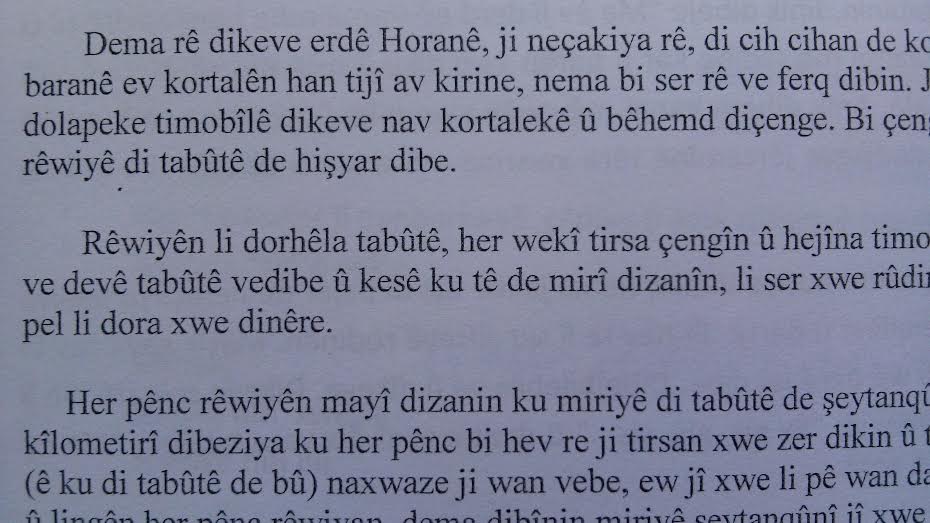
No clue what it says. Click to enlarge.
Teacher Hasan let me read. Reading Kurdish isn’t hard, since it is written very phonetically, like Turkish. But I shrunk to such small dimensions in class that I didn’t even recognize my own voice when I read. It’s weak, and my throat was so clogged up with emotion that the words hardly came out. ‘See!’ said Hasan nevertheless after I read a paragraph, ‘you can read very well!’. I stuttered: ‘But I have no clue what I read’.
‘Learn ten words a day’, Hasan said. I explained how impossible that is. Kurdish words don’t resemble any words in other languages I know, it takes time before they really stick in my brain. ‘How did you learn Turkish?’ Hasan asked. Also with frustration, definitely, but it was different. In Üsküdar I passed the sign ‘balık çarşısı’ (fish market) every day, the names of the fish, alabalık, çupra and levrek, nicely written on signs. That helped. Just like seeing a sign ‘domates’ on the tomatoes, ‘salatalık’ on the cucumbers and ‘elma’ on the apples helped. And you learn what a ‘fırıncı’ (bakery shop) is after waiting next to it for a dolmus on a daily basis. In Amed, all the signs are in Turkish too. Please, shop owners, help me a little bit, and change your signs to Kurdish! Masîgirî on the fish shop, firinkar on the bakery shop, sêv on the apples, mirîşk on the chicken.
Prison and occupied
I regularly buy Azadiya Welat and add words from the paper to the small booklet in which I make a list of words. The words from Azadiya Welat are easy to detect in that list: girtîgeh (prison), xweser (autonomous), herêm (district), çalakî (action), dagir (occupied) for example. Not words I need in this stage of language learning.
Teacher Hasan and my class mates refused to let me go on Sunday. Through my tears I explained that Kurdi-Der is just not the place for me, that the classes just don’t provide what I need on my level. They agreed, but insisted I stayed. And so I reluctantly sat down again. Immediately, one of my class mates sat down right next to me, and whispered explanations in Turkish in my ear and scribbled down Turkish translations of words in the text book. After class, I said: ‘I do love you all for being so helpful’, and they said: ‘We love you too, and we won’t let you down. We will help you learn.’ Which instantly made me cry again, of course. I feel a bit ashamed now, of being such a drama queen.
I did a Google search on language learning and emotions. I think I can diagnose myself with ‘language anxiety’, and I have an extreme form. I could find backgrounds, but none of them saying anything on how to break the anxiety. I guess there is only one thing I can do: persist, and let my friends both at Kurdi-Der and my other friends in town help me. I will not give up. I may hate language learning, but from my experiences with Turkish I know: I love language knowing. Serkeftin!